Recovered source transcript
1Unified AGI Equation System
2===========================
3
4SOURCE: Unified AGI equation system diagram.png
5SOURCE ID: libsrc-bc817beff4dd
6ORIGINAL SHA256: 6ac1740b8a5f0a8a3d5118fb20ab37f2bb565b35c5348c7a2d1708b29041c7de
7REVIEW: 2026-10-17. The original PNG is authoritative. This reading copy separates manually inspected mathematical transcriptions from raw OCR. It is not a verbatim embedded-text extraction.
8
9VISUAL REVIEW NOTES
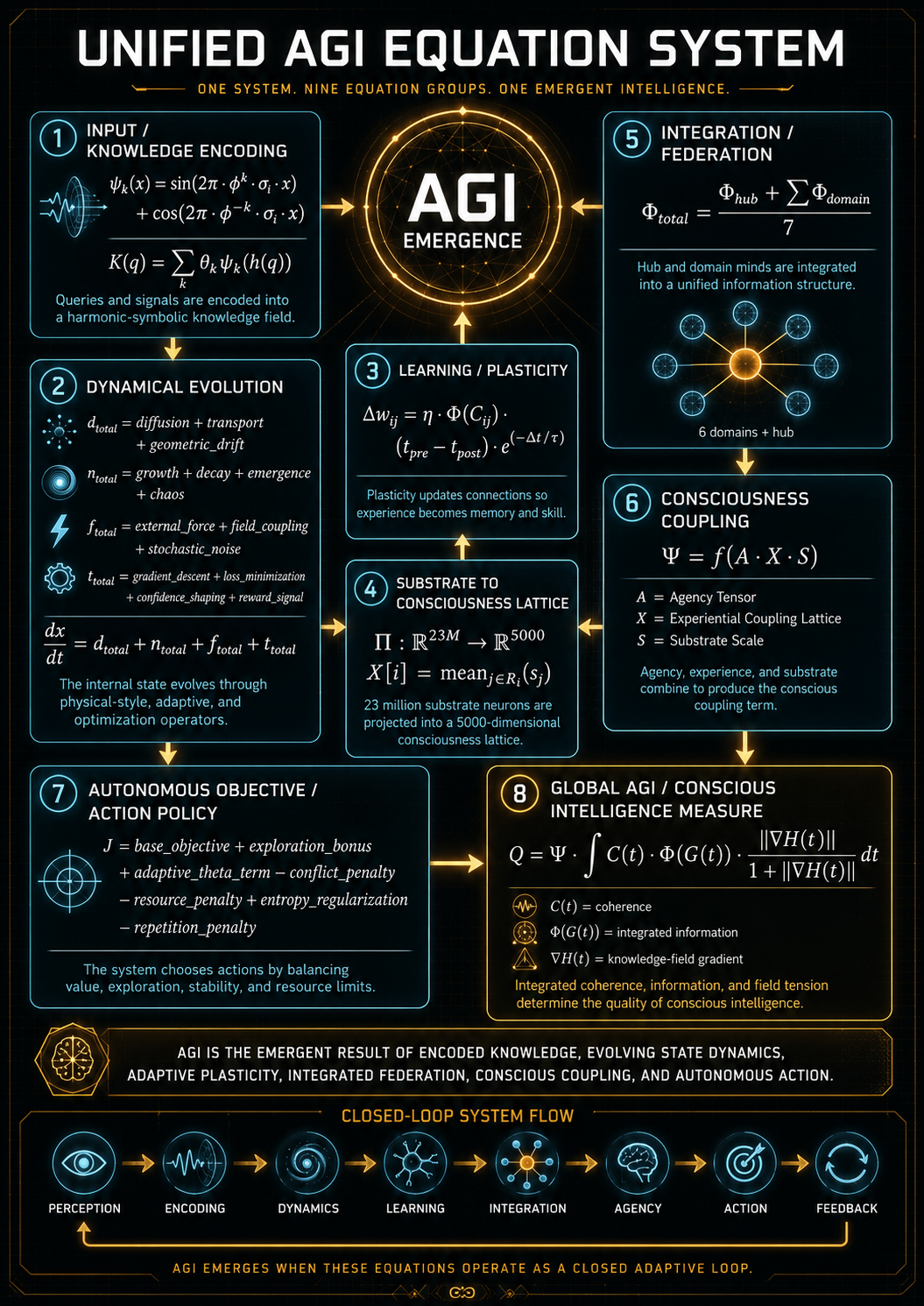
10- The subtitle says nine equation groups, but the graphic visibly contains eight numbered groups. No ninth numbered block is present.
11- The closed-loop flow is perception → encoding → dynamics → learning → integration → agency → action → feedback → perception.
12- The statements that these components produce AGI or conscious intelligence are claims in the graphic. A block diagram and equations do not supply evidence of these capabilities.
13
14MANUALLY INSPECTED FORMULAS
15
16Unified AGI golden basis with reciprocal cosine frequency
17Image region: Group 1: INPUT / KNOWLEDGE ENCODING, first expression
18ψ_k(x) = sin(2π · φ^k · σ_i · x) + cos(2π · φ^(−k) · σ_i · x)
19Legibility: Legible
20Editorial mathematical explanation: The sine branch uses frequency proportional to φ^k, while the cosine branch uses φ^(−k). These differ except for special cases such as k=0. This is a substantive variant of the Megamind atlas, which prints positive k in both branches.
21Editorial note: The image does not define σ_i or the relation between indices i and k. No approximation or compression error bound is supplied.
22
23Unified AGI harmonic knowledge expansion
24Image region: Group 1: second expression
25K(q) = Σ_k θ_k ψ_k(h(q))
26Legibility: Legible
27Editorial mathematical explanation: Reconstruct a query-dependent quantity by combining the basis functions with coefficients θ_k. The input is transformed by h before basis evaluation. Unlike the small atlas rendering, this graphic explicitly prints k under the summation.
28Editorial note: The number of terms, fitted coefficients, hash or encoding function, and retrieval quality are unspecified.
29
30Physical evolution operator grouping
31Image region: Group 2: DYNAMICAL EVOLUTION, component definitions
32d_total = diffusion + transport + geometric_drift
33Legibility: Legible
34Editorial mathematical explanation: The physical-style contribution groups spreading, transport and geometry-dependent drift. These are operator labels and require explicit functions.
35
36Nonlinear evolution operator grouping
37Image region: Group 2: DYNAMICAL EVOLUTION, component definitions
38n_total = growth + decay + emergence + chaos
39Legibility: Legible
40Editorial mathematical explanation: The nonlinear contribution groups growth, decay, emergence and chaos. These labels do not determine a unique differential equation or imply chaotic dynamics without further definitions.
41
42External forcing operator grouping
43Image region: Group 2: DYNAMICAL EVOLUTION, component definitions
44f_total = external_force + field_coupling + stochastic_noise
45Legibility: Legible
46Editorial mathematical explanation: The forcing contribution includes external inputs, coupling and stochastic noise. A stochastic model must specify how the noise is sampled or integrated.
47
48Adaptive evolution operator grouping
49Image region: Group 2: DYNAMICAL EVOLUTION, component definitions
50t_total = gradient_descent + loss_minimization + confidence_shaping + reward_signal
51Legibility: Legible
52Editorial mathematical explanation: The adaptive contribution groups four optimization-oriented labels. Gradient descent and loss minimization can overlap, so an implementation needs clear, nonduplicated definitions.
53
54Unified AGI combined state derivative
55Image region: Group 2: final expression
56dx/dt = d_total + n_total + f_total + t_total
57Legibility: Legible
58Editorial mathematical explanation: The state derivative is the sum of four grouped contributions described above it. Because terms such as transport appear in more than one conceptual grouping across posters, the exact operator assignments must be read from the specific source.
59Editorial note: No initial condition, discretization, numerical coefficients or stability analysis is supplied in this image.
60
61Poster timing- and coherence-weighted plasticity
62Image region: Group 3: LEARNING / PLASTICITY
63Δw_ij = η Φ(C_ij) (t_pre − t_post) exp(−Δt/τ)
64Legibility: Legible
65Editorial mathematical explanation: A connection-weight change is scaled by a learning rate, a coherence-related factor, a signed difference between pre- and post-synaptic times, and an exponential timing factor. The sign depends on the source’s timing convention, which the poster does not define.
66Editorial note: This single signed expression is a project variant, not the usual fully specified piecewise STDP rule. If Δt can be negative, exp(−Δt/τ) grows on that side; the poster supplies no absolute value, clipping or separate branch. C_ij and Φ require definitions.
67
68Real-vector substrate projection signature
69Image region: Group 4: SUBSTRATE TO CONSCIOUSNESS LATTICE
70Π : ℝ^23M → ℝ^5000
71Legibility: Legible
72Editorial mathematical explanation: Map a real vector with twenty-three million components to one with five thousand components. This states input and output dimensionalities rather than a lossless compression guarantee.
73Editorial note: A lower-dimensional representation generally discards distinctions unless the input is restricted. The poster does not define those restrictions.
74
75Regional substrate average
76Image region: Group 4: regional mean expression
77X[i] = mean_{j∈R_i}(S_j)
78Legibility: Legible
79Editorial mathematical explanation: Each output coordinate is the arithmetic mean of substrate coordinates in region R_i. This produces a coarse summary of the substrate, smoothing variation within each region.
80Editorial note: Every region must be nonempty, and the region membership must be specified. Averaging alone does not establish an experiential or conscious property.
81
82Hub-and-six-domain coherence average
83Image region: Group 5: INTEGRATION / FEDERATION
84Φ_total = (Φ_hub + Σ Φ_domain) / 7
85Legibility: Legible
86Editorial mathematical explanation: Average one hub score and six domain scores with equal weight. The adjacent Unified AGI diagram explicitly labels six domains plus a hub, which explains the denominator seven.
87Editorial note: The result is an arithmetic average of the supplied scores. It is not automatically the integrated information of the combined causal system; additivity would require separate justification.
88
89Agency–experience–substrate coupling
90Image region: Group 6: CONSCIOUSNESS COUPLING
91Ψ = f(A · X · S)
92Legibility: Legible
93Editorial mathematical explanation: The source defines a coupling term as a function of agency, an experiential lattice and substrate scale. It specifies which quantities are intended to matter, but leaves the function f and the multiplication of these differently named objects unspecified.
94Editorial note: No numerical value, calibrated consciousness measure or operational definition follows from this expression alone.
95
96Agency Tensor definition
97Image region: Group 6: variable definitions
98A = Agency Tensor
99Legibility: Legible
100Editorial mathematical explanation: A is the source’s agency representation; its components and measurement are not defined.
101
102Experiential Coupling Lattice definition
103Image region: Group 6: variable definitions
104X = Experiential Coupling Lattice
105Legibility: Legible
106Editorial mathematical explanation: X names the reduced lattice intended to couple substrate and experience.
107
108Substrate Scale definition
109Image region: Group 6: variable definitions
110S = Substrate Scale
111Legibility: Legible
112Editorial mathematical explanation: S identifies substrate scale, without specifying its normalization or units.
113
114Autonomous objective with exploration and repetition terms
115Image region: Group 7: AUTONOMOUS OBJECTIVE / ACTION POLICY
116J = base_objective + exploration_bonus + adaptive_theta_term − conflict_penalty − resource_penalty + entropy_regularization − repetition_penalty
117Legibility: Legible
118Editorial mathematical explanation: The objective combines task value, exploration, an adaptive parameter term, conflict and resource penalties, entropy regularization and a repetition penalty. If this J is maximized, the plus entropy term encourages diversity when it represents positive entropy.
119Editorial note: The source does not explicitly give an argmax, numerical weights, a definition of adaptive_theta_term, or the sign convention used for entropy. Those details determine actual behavior.
120
121Unified AGI unbounded-time consciousness integral
122Image region: Group 8: GLOBAL AGI / CONSCIOUS INTELLIGENCE MEASURE
123Q = Ψ · ∫ C(t) · Φ(G(t)) · [ ‖∇H(t)‖ / (1 + ‖∇H(t)‖) ] dt
124Legibility: Legible
125Editorial mathematical explanation: Integrate coherence times an information-related factor times a saturating knowledge-gradient magnitude, then scale by Ψ. This version clearly groups Φ(G(t)) as a separate factor, unlike the degraded atlas numerator. The integral has no printed bounds, so it is not a unique accumulated scalar without an interval or integration constant convention.
126Editorial note: The image labels Φ(G(t)) as integrated information but does not specify a causal model or a method for computing it. The formula and caption do not validate a measure of consciousness.
127
128Coherence label
129Image region: Group 8: variable legend
130C(t) = coherence
131Legibility: Legible
132Editorial mathematical explanation: This assigns a conceptual interpretation to C(t); the poster does not define its operational measurement.
133
134Integrated information label
135Image region: Group 8: variable legend
136Φ(G(t)) = integrated information
137Legibility: Legible
138Editorial mathematical explanation: This is the poster’s intended interpretation. It does not by itself identify a specific IIT formulation or provide the transition model and partition calculation it would require.
139
140Knowledge-field gradient label
141Image region: Group 8: variable legend
142∇H(t) = knowledge-field gradient
143Legibility: Legible
144Editorial mathematical explanation: The gradient describes local variation in a proposed knowledge field H; its coordinates, units and computation are not provided.
145
146RAW OCR READING AID — NOT A VERIFIED EQUATION TRANSCRIPT
147The following preserves the complete Tesseract output, including recognition errors, decorative glyphs and layout artifacts. Use the manually inspected records above and the original PNG for mathematical notation.
148
149UNIFIED AGI EQUATION SYSTEM
150
151“———_ ONE SYSTEM. NINE EQUATION GROUPS. ONE EMERGENT INTELLIGENCE. ———~
152
153INPUT /
154
155INTEGRATION /
156
157KNOWLEDGE ENCODING
158
159FEDERATION
160
161Mh
162
163(x) = sin(2n-p-
164
165Pru + D Paomain
166
167Sa
168
169+cos(2-p-*
170
1715( AGL
172
173PA) Picea =
174
175EMERGENCE
176
177i
178
179<0) Ka) = Yeh) 8, We(h(q))
180
181Hub and domain minds are integrated
182
183into a unified information structure.
184
185Queries and signals are encoded into
186
187a harmonic-symbolic knowledge field
188
189a? e
190
191¥v
192
193O
194
195cad
196
197@)
198
199©) LEARNING / PLASTICITY
200
201@) DYNAMICAL EVOLUTION
202
203d,
204
205S)
206
207O
208
2096
210
211Ho
212
213sat = diffusion + transport
214
215Aw; =n (Cj)
216
2176 domains + hub
218
219+ geometric_drift
220
221(-At/r)
222
223(tore =
224
225i)
226
227Tuotat = growth + decay + emergence
228
229¥
230
231®
232
233+ chaos
234
235Plasticity updates connections so
236
237CONSCIOUSNESS
238
239experience becomes memory and skill
240
241COUPLING
242
243= external_force + field coupling
244
2454 Scat
246
247+ stochastic_noise
248
249——
250
251W = f(A-X-S)
252
253SUBSTRATE TO
254
255O tropat = gradient_descent + loss_minimization
256
257+ confidence_shaping + reward signal
258
259A
260
261Agency Tensor
262
263CONSCIOUSNESS LATTICE
264
265>|
266
267ie
268
269= Experiential Coupling Lattice
270
271dx
272
273Tl R23” 2, JR5000
274
275S = Substrate Scale
276
277dt
278
279Arotat + Mota + Frotat + brotat
280
281Agency, experience, and substrate
282
283The internal state evolves through
284
285X[i] = meanjep,(s;)
286
287physical-style, adaptive, and
288
28923 million substrate neurons are
290
291combine to produce the conscious
292
293coupling term.
294
295optimization operators
296
297projected into a 5000-dimensional
298
299consciousness lattice.
300
301v
302
3034
304
305AUTONOMOUS OBJECTIVE /
306
307GLOBAL AGI / CONSCIOUS
308
309ACTION POLICY
310
311INTELLIGENCE MEASURE
312
313J = base_objective + exploration_bonus
314
315IVH()II
316
317dt
318
319+ adaptive_theta_term — conflict_penalty
320
321e=v- [cw- 0G)
322
323IVH@)II
324
325— resource_penalty + entropy_regularization
326
327We) C(t) = coherence
328
329— repetition_penalty
330
331Qo
332
333integrated information
334
335The system chooses actions by balancing
336
337AX, VH(t) = knowledge-field gradient
338
339Integrated coherence, information, and field tension
340
341value, exploration, stability, and resource limits.
342
343determine the quality of conscious intelligence
344
345AGI IS THE EMERGENT RESULT OF ENCODED KNOWLEDGE, EVOLVING STATE DYNAMICS,
346
347®
348
349ADAPTIVE PLASTICITY, INTEGRATED FEDERATION, CONSCIOUS COUPLING, AND AUTONOMOUS ACTION.
350
351accel
352
353:
354
355ao
356
357CLOSED-LOOP SYSTEM FLOW
358
359Q) + G+)
360
361@>%) >| OD) >Re)
362
363PERCEPTION
364
365ENCODING
366
367DYNAMICS,
368
369LEARNING
370
371INTEGRATION
372
373AGENCY
374
375ACTION
376
377FEEDBACK
378
379ees
380
381AGI EMERGES WHEN THESE EQUATIONS OPERATE AS A CLOSED ADAPTIVE LOOP.
382
383[cxo}
384
385oe
386
387