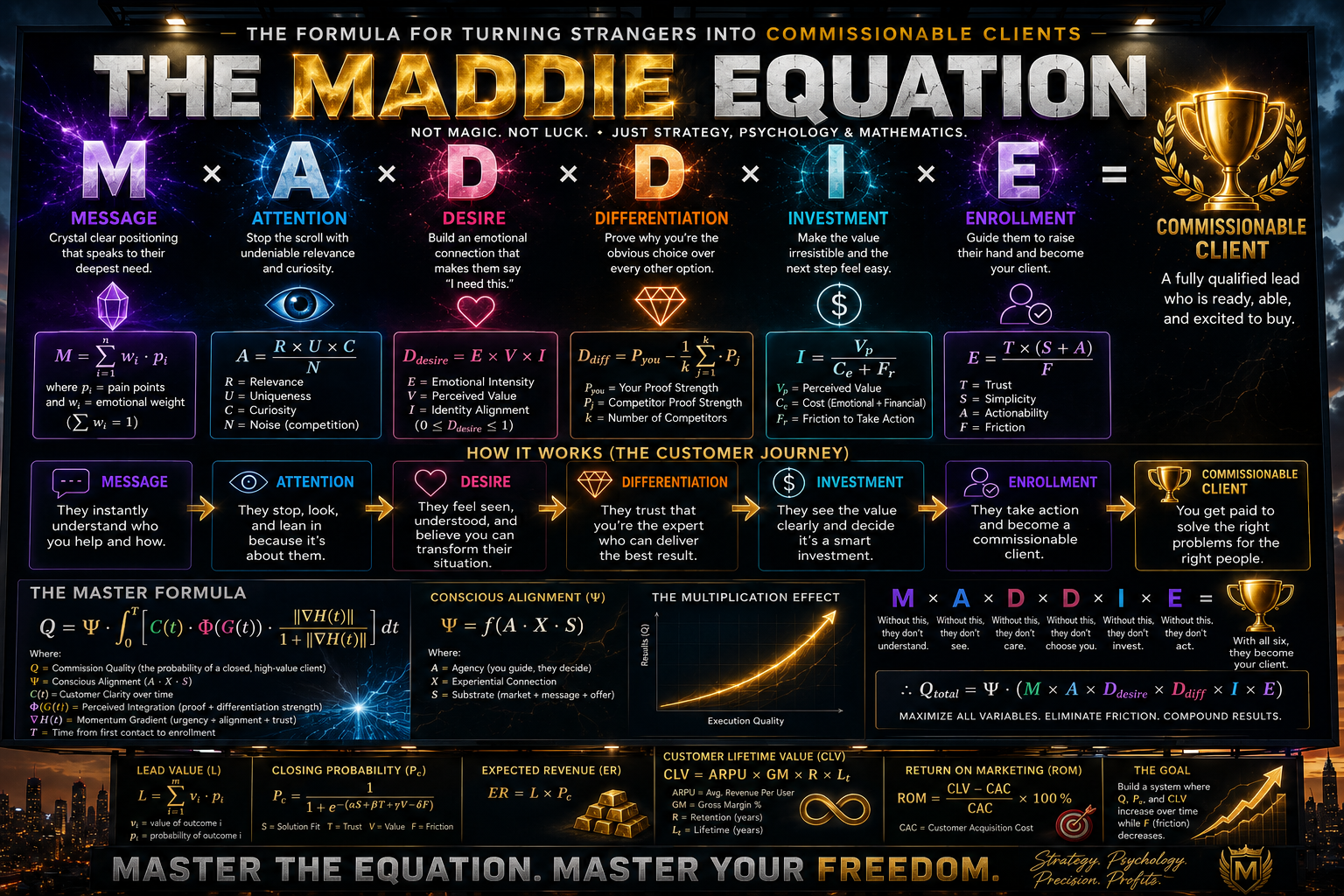
Recovered source transcript
1The MADDIE Equation — Client Conversion Formula
2===============================================
3
4SOURCE: The Maddie Equation: Client Conversion Formula.png
5SOURCE ID: libsrc-a7c47b90b5d4
6ORIGINAL SHA256: 2ec6640a14e314b61f3fe465fa7340101c7b309f4dee5c3336727a8d739932fb
7REVIEW: 2026-10-17. The original PNG is authoritative. This reading copy separates manually inspected mathematical transcriptions from raw OCR. It is not a verbatim embedded-text extraction.
8
9VISUAL REVIEW NOTES
10- The smaller multiplication-effect graph is an illustrative curve of Results (Q) versus Execution Quality, not a displayed analytic equation or measured dataset.
11- The same letters are deliberately overloaded among component boxes; the transcript preserves local meanings instead of imposing a global symbol dictionary.
12- Claims of predictable commissions and conversion are the poster’s intended application. This review establishes visible source content only, not empirical effectiveness.
13
14MANUALLY INSPECTED FORMULAS
15
16MADDIE six-factor product
17Image region: Large top equation and smaller repeated row above total formula
18M × A × D × D × I × E = [trophy / commissionable client]
19Legibility: Legible
20Editorial mathematical explanation: Restates the six-factor conversion framework.
21Editorial note: Desire and Differentiation share the displayed D glyph in this schematic product; component boxes distinguish them.
22Editorial note: Duplicates the simple MADDIE clients poster.
23
24Message weighted pain-point score
25Image region: Message component box
26M = Σ_{i=1}^{n} w_i · p_i
27Legibility: Legible
28Editorial mathematical explanation: Forms message from weighted pain-point quantities.
29Editorial note: The image defines pain points and emotional weights but does not specify their measurement scales.
30
31Message-weight normalization
32Image region: Bottom of Message component box
33Σ_i w_i = 1
34Legibility: Legible
35Editorial mathematical explanation: The message weights sum to one.
36Editorial note: The displayed normalization does not state bounds or nonnegativity for individual weights.
37
38Attention score
39Image region: Attention component box
40A = (R × U × C) / N
41Legibility: Legible
42Editorial mathematical explanation: Combines relevance, uniqueness, and curiosity and divides by noise/competition.
43Editorial note: R = Relevance; U = Uniqueness; C = Curiosity; N = Noise (competition).
44Editorial note: The image does not define zero-noise handling.
45
46Desire score
47Image region: Desire component box
48D_desire = E × V × I
49Legibility: Legible
50Editorial mathematical explanation: Multiplies emotional intensity, perceived value, and identity alignment.
51Editorial note: These E and I symbols are local component meanings; E and I in the overall MADDIE product denote enrollment and investment.
52
53Desire range
54Image region: Bottom of Desire component box
550 ≤ D_desire ≤ 1
56Legibility: Legible
57Editorial mathematical explanation: States a range for the desire score.
58Editorial note: No explicit normalization of E, V, or I is supplied to ensure this bound.
59
60Differentiation score
61Image region: Differentiation component box
62D_diff = P_you − (1/k) Σ_{j=1}^{k} P_j
63Legibility: Legible
64Editorial mathematical explanation: Subtracts mean competitor proof strength from your proof strength.
65Editorial note: k = Number of competitors; k = 0 is not addressed.
66Editorial note: The displayed subtraction can produce a negative result; the poster gives no clipping rule.
67
68Investment score
69Image region: Investment component box
70I = V_p / (C_e + F_r)
71Legibility: Legible
72Editorial mathematical explanation: Divides perceived value by emotional/financial cost plus friction to take action.
73Editorial note: The denominator must be defined to evaluate the ratio; the image supplies no units or zero-denominator convention.
74
75Enrollment score
76Image region: Enrollment component box
77E = [T × (S + A)] / F
78Legibility: Legible
79Editorial mathematical explanation: Scales simplicity plus actionability by trust and divides by friction.
80Editorial note: Local T = Trust, S = Simplicity, A = Actionability, and F = Friction. These symbols are reused with other meanings elsewhere on the same poster.
81
82Master commission-quality integral
83Image region: Lower-left THE MASTER FORMULA panel
84Q = Ψ · ∫_0^T [ C(t) · Φ(G(t)) · ( ||∇H(t)|| / (1 + ||∇H(t)||) ) ] dt
85Legibility: Legible
86Editorial mathematical explanation: Accumulates customer clarity times perceived integration over the contact-to-enrollment period, modulated by the bounded gradient-norm factor and conscious alignment.
87Editorial note: The poster calls Q a probability, but the displayed unrestricted time integral and multiplier do not themselves impose a 0–1 range.
88Editorial note: No units, measurements, operational definition of G or H, integration data, or fitted model are provided in the image.
89Editorial note: The visibly displayed gradient argument is H(t), not a Hamiltonian definition supplied elsewhere.
90
91Conscious-alignment function
92Image region: CONSCIOUS ALIGNMENT (Ψ) panel
93Ψ = f(A · X · S)
94Legibility: Legible
95Editorial mathematical explanation: Makes conscious alignment an unspecified function of agency, experiential connection, and substrate.
96Editorial note: The function f is not defined. The nearby Master Formula legend also describes Ψ as conscious alignment (A · X · S), without explicitly writing the f.
97
98Total MADDIE quality product
99Image region: Lower-right boxed total formula
100∴ Q_total = Ψ · (M × A × D_desire × D_diff × I × E)
101Legibility: Legible
102Editorial mathematical explanation: Multiplies alignment by the six explicitly distinguished conversion components.
103Editorial note: The poster does not derive equivalence between this algebraic product and the separate time-integral Q. Treat them as related source formulations.
104
105Lead value
106Image region: Bottom strip LEAD VALUE (L)
107L = Σ_{i=1}^{n} v_i · p_i
108Legibility: Legible
109Editorial mathematical explanation: Adds each outcome value weighted by its probability.
110Editorial note: In this formula p_i denotes an outcome probability, unlike the pain-point p_i in the Message component.
111Editorial note: No probability distribution, outcome set, or measured outcome values are given.
112
113Closing probability
114Image region: Bottom strip CLOSING PROBABILITY (P_c)
115P_c = 1 / [1 + e^{−(αS + βT + γV − δF)}]
116Legibility: Legible
117Editorial mathematical explanation: Uses a logistic mapping of solution fit, trust and value, with friction subtracted.
118Editorial note: S = Solution Fit; T = Trust; V = Value; F = Friction.
119Editorial note: The coefficients α, β, γ, δ are displayed but not estimated or defined numerically.
120
121Expected revenue
122Image region: Bottom strip EXPECTED REVENUE (ER)
123ER = L × P_c
124Legibility: Legible
125Editorial mathematical explanation: Multiplies lead value by closing probability.
126Editorial note: The source provides a formula but no data with which to validate or compute expected revenue.
127
128Customer lifetime value
129Image region: Bottom strip CUSTOMER LIFETIME VALUE (CLV)
130CLV = ARPU × GM × R × L_t
131Legibility: Legible
132Editorial mathematical explanation: Combines average revenue per user, gross margin, retention and lifetime as the poster specifies.
133Editorial note: The source labels both R (retention) and L_t (lifetime) in years. Their separate operational definitions and resulting dimensions are not resolved in the image.
134Editorial note: GM is labeled Gross Margin %, but whether it is entered as a fraction or a percent number is not stated.
135
136Return on marketing
137Image region: Bottom strip RETURN ON MARKETING (ROM)
138ROM = [(CLV − CAC) / CAC] × 100%
139Legibility: Legible
140Editorial mathematical explanation: Expresses the difference between customer lifetime value and acquisition cost relative to acquisition cost.
141Editorial note: CAC = Customer Acquisition Cost. No zero-cost convention or observed values are given.
142
143SOURCE-LOCAL SYMBOL DEFINITIONS
144M = Message score. In its component formula p_i denotes pain points and w_i emotional weight.
145A (main product) = Attention score.
146D_desire = Desire. E denotes emotional intensity; V perceived value; I identity alignment within this component.
147D_diff = Differentiation. P_you denotes your proof strength; P_j competitor proof strength; k number of competitors.
148I (main product) = Investment score. V_p is perceived value; C_e emotional plus financial cost; F_r friction to take action.
149E (main product) = Enrollment. T is trust; S simplicity; A actionability within this component. F is friction.
150Q = Commission quality, described by the poster as probability of a closed, high-value client.
151Ψ = Conscious alignment. In this component A is agency (you guide, they decide), X experiential connection, and S substrate (market + message + offer).
152C(t) = Customer clarity over time.
153Φ(G(t)) = Perceived integration: proof and differentiation strength.
154∇H(t) = Momentum gradient: urgency, alignment, trust.
155T (integral) = Time from first contact to enrollment.
156L = Lead value. In this component v_i is value of outcome i and p_i probability of outcome i.
157P_c = Closing probability. S is solution fit, T trust, V value, and F friction.
158ER = Expected revenue.
159CLV = Customer lifetime value.
160ARPU = Average revenue per user.
161GM = Gross margin percent, as labeled.
162R = Retention, labeled years.
163L_t = Lifetime, labeled years.
164CAC = Customer acquisition cost.
165ROM = Return on marketing.
166
167RAW OCR READING AID — NOT A VERIFIED EQUATION TRANSCRIPT
168The following preserves the complete Tesseract output, including recognition errors, decorative glyphs and layout artifacts. Use the manually inspected records above and the original PNG for mathematical notation.
169
170— THE FORMULA FOR TURNING STRANGERS INTO COMMISSIONABLE CLIENTS —
171
172HE MAD
173
174-
175
176DIE EQUATION
177
178NOT MAGIC. NOT LUCK.
179
180+ JUST STRATEGY, PSYCHOLOGY & MATHEMATICS.
181
182WV
183
184igi
185
186x i]
187
188SS
189
190*
191
192* x
193
194MESSAGE
195
196ATTENTION
197
198DESIRE
199
200DIFFERENTIATION
201
202INVESTMENT
203
204ENROLLMENT
205
206i
207
208COMMISSIONABLE
209
210Crystal clear positioning
211
212Stop the scroll with
213
214Build an emotional
215
216Prove why you're the
217
218Make the value
219
220Guide them to raise
221
222that speaks to their
223
224undeniable relevance
225
226connection that
227
228‘obvious choice over
229
230irresistible and the
231
232their hand and become
233
234CLIENT
235
236deepest need.
237
238and curiosity.
239
240makes them say
241
242every other option.
243
244next step feel easy.
245
246your client.
247
248“I need this.
249
250A fully qualified lead
251
252who is ready, able,
253
254<a>
255
256@
257
258Co
259
260and excited to buy.
261
262RxUxC
263
264lial
265
266T x(S+A)
267
268M=) wi: Pi
269
270A
271
272Dacsirve = Ex Vx I
273
274Daigg = Pyou -
275
276v-P;
277
278> Crt Fy
279
280where p;
281
282pain points
283
284R = Relevance
285
286E = Emotional intensity
287
288Pyoy = Your Proof Strength
289
290Vp = Perceived Value
291
292T = Trust
293
294and w, = emotional weight
295
296U = Uniqueness
297
298V = Perceived Value
299
300mpetitor Proof Strength
301
302Cz = Cost (Emotional + Financial)
303
304Simplicity
305
306C = Curiosity
307
308I = Identity Alignment
309
310k
311
312= Friction to Take Action
313
314A = Actionability
315
316(Sw = 1)
317
318N= Noise (competition)
319
320(0 < Daesice $1)
321
322lumber of Competitors
323
324= Friction
325
326HOW IT WORKS (THE CUSTOMER JOURNEY)
327
328DESIRE
329
330COMMISSIONABLE
331
332=) MESSAGE
333
334<—} ATTENTION |
335
336| LY DIFFERENTIATION
337
338©) investment
339
340CLIENT
341
342They feel seen,
343
344Ao ENROLLMENT LJ yy
345
346They instantly
347
348They stop, look,
349
350|
351
352understood, and
353
354>
355
356They trust that
357
358=» They see the value
359
360They take action
361
362You get paid to
363
364understand who
365
366|
367
368and lean in
369
370you're the expert
371
372clearly and decide
373
374and become a
375
376solve the right
377
378you help and how.
379
380because it's
381
382transform their
383
384believe you can
385
386who can deliver
387
388it's a smart
389
390commissionable
391
392problems for the
393
394about them.
395
396|
397
398situation
399
400the best result.
401
402investment.
403
404i
405
406client.
407
408right people:
409
410|
411
412as
413
414THE MASTER FORMULA
415
416CONSCIOUS ALIGNMENT (¥)
417
418THE MULTIPLICATION EFFECT
419
420Mx«AxDxDx«Ix«E
421
422IVA(OIL
423
424Without this, Without this
425
426Without this, Without this,
427
428Without this, Without this,
429
430Q=v- f [c@-oG@)
431
432Jae
433
434W = f(A-X-S)
435
436|
437
438they don’t
439
440they don't
441
442they don't
443
444they don't
445
446they don’t
447
448they don't
449
450With all six,
451
452Where:
453
4541+ |IVH(6)Il
455
456er
457
458Understand.
459
460s
461
462care.
463
464‘choose you.
465
466invest.
467
468act.
469
470they become
471
472Q
473
474ial
475
476es
477
478your client.
479
480Commission Quality (the probability ofa closed, high-value client)
481
482\gency (you guide, they decide)
483
484r
485
486a)
487
488\W = Conscious Alignment (A - X + $)
489
490-xperiential Connection
491
492aa
493
494Qtotat
495
496(G(()) = Perceived Integration (proof + differentiation strengt
497
498ustomer Clarity overtime
499
500Substrate (market + message + offer)
501
502W-(M x A xX Deesire X Daigg x I x E)
503
504VH(£) = Momentum Gradient (urgency + alignment + trust)
505
506va
507
508=i
509
510MAXIMIZE ALL VARIABLES. ELIMINATE FRICTION. COMPOUND RESULTS.
511
512T = Time from first contact to enrollment
513
514Ne
515
516Execution Quality
517
518al
519
520=
521
522a
523
524=
525
526=
527
528——
529
530=
531
532=
533
534==
535
536‘CUSTOMER LIFETIME VALUE (CLV)
537
538=
539
540=
541
542———
543
544——r
545
546LEAD VALUE (L)
547
548CLOSING PROBABILITY (P¢!
549
550RETURN ON MARKETING (ROM)
551
552THE GOAL
553
554| EXPECTED REVENUE (ER)
555
556CLV = ARPU x GM x R x Ly
557
558Pi
559
560a
561
562cl
563
564|ARPU = Aug, Revenue Per User
565
566ROM =
567
568CLV — CAC
569
570100 %
571
572Q, P., and CLV
573
574Build a system where
575
576L= yy
577
578fl
579
580[4 e-(@S+BT+7V-6F)
581
582GM = Gross Margin %
583
584CAC
585
586increase over time
587
588= value of outcome i
589
590$= Solution Fit T= Trust V= Value F= Friction
591
592R= Retention (years)
593
594(ee)
595
596while F (friction)
597
598= probsbilty of outcome
599
600| ER= "
601
602Le = Lifetime (years)
603
604CAC = Customer Acquistion Cost
605
606decreases.
607
608ee
609
610_MASTER THE EQUATION. MASTER YOUR F FREEDOM.
611
612Soalay. are
613
614mw
615
616Precision. Doofits
617
618